Shawn Mackey, Inspired by the Islands of Hawaii

On August 11, 1984 artist Shawn Mackey was born in Edmonton Canada. Growing up during the long cold winters gave Shawn ample time to to draw and his creativity had no limits. Every sheet of scrap paper and copy paper was used to draw on. He would draw cartoon characters, cars, floor plans and anything that drew his attention, he even created his own superheroes that came purely from his own imagination.

At the tender age of 8 he was collecting money from his friends for his hand drawn pictures of cars, Shawn Mackey was born with an entrepreneurial spirit. He also was using ink and colored markers to create tattoos on his friends in the school bathrooms. His teachers gave him many lectures for this, but it didn’t stop him from creating.

Once he graduated high school he decided to put a hold on his art and pursue a college education at university with an emphasis on becoming a lawyer. A year of classes later that we’re filled with essay writing, politics and economics had not quelled his longing to create. Like all natural artists they have creativity in their bones and it could not be contained any longer. He deiced to take a summer art course and once he began to put paint on canvas he decided to transfer to the fine art program and study painting instead.

Shawn had also considered being an architect, but realized the canvas was the only place that he had the true freedom to create whatever he wanted to create, whenever he wanted to create. To be totally free when creating art was what Shawn wanted to to do and the ability to tell a story with a painting and to draw forth emotions from the viewer was what Shawn wanted to do the most.

Experimenting with abstractions came next and he did this while he was completing his Bachelors of Fine Art degree. Shawn used a variety of mediums such as oil, acrylic paint, polymer mediums and even earth to create these abstractions. Shawn was searching for new ways to bring new life into an art from that had been around for centuries. While he was in art school he worked as a bartender which greatly influenced his later work with the love of fine wines and spirits, which he portrayed in such paintings as “Dancing In The Streets” and “Dream Girl”.

Shawn graduated art school and pursued a variety of random jobs afterwards, but then he returned to school to become an art teacher. During this period of time Shawn considers this to be his biggest growth in his artistic journey. When he had time off he began to study in detail the great masters of art history. Today, Shawn Mackey focus is on Hawaiian Art. The impressionists were first and he worked his way through the ages learning their techniques. Like all artists he did put his own twist on their techniques and put his own mark on the pieces he created.

Shawn Mackey is being inspired today by the islands of Hawaii and his newest pieces bring out the beauty of the people, the location and the culture. His artwork is layered with texture and feels dramatic. The Hawaiian Islands are captured with vibrant colors, you can feel the breeze on your skin and hear the waves washing upon the shore. Shawn is able to capture the feeling of being there with his brushstrokes and create a painting that brings that feeling to you each and every time you view it.

Josef Kote, Contemporary Painter

When Albanian born Josef Kote was growing up he was always drawing and being a fine artist. By the age of 13 Kote had made up his mind to become an artist so once that decision was made his focus was on making that happen. When Josef Kote was in high school he applied and was accepted into the finest art school in Albania, he also competed locally and nationally in art shows, he was awarded a spot at the coveted “National Lyceum of Art” in Tirana.

Josef was accepted into the “Academy of Fine Arts” of Tirana in 1984 where he was educated in the techniques of the masters of fine art and the traditional approach they used to create works that we know and love today. As most artists do they have their own style and once they learn these techniques they want to break loose and do what comes naturally to them. Josef wanted to explore, experiment and grow, he wanted to paint with no boundaries and we can see that in his paintings today. The vibrant colors and layers of paint that reveal emotions hidden and revealed in each piece.

His trademark ‘s are bold brushstrokes, such as reflected in Josef Kote’s piece Beyond the Fall, that sweep across the canvas, the texture comes from the pallet knife breaking over the art canvas as the paint is applied and as you look you notice some parts of the canvas have not even been touched creating negative space that lets your eyes drift away and then come back to rest.

When you view one of Josef Kote art, his use of color and light are music to the eyes, such as reflected in Kote’s Unexpected Light. Their composition is romantic, stunning and calming. His years of experimenting show with edgy colors and thick pallet knife texture, he adds elements of the masters and then uses abstract elements, fusing them all together with drips of paint to create shadow and light drawing us into the piece.

Josef Kote art has always been influenced by the places he has lived and In 2009 Josef moved to New York and his art is now influenced by the city he lives in, the architecture, the people and the life he lives in New York can all be seen in his latest works of fine art. Each painting is a snapshot captured in time with his masterful and practiced hand.


Fimocreations by Artist Jon Stuart Anderson

Jon Stuart Anderson is a world renowned polymer clay artist who is globally collected. These handmade, intricately detailed animals, are made with a millefiore technique, have been acquired by collectors as diverse as US President Bill Clinton, Pearl Jam drummer Dave Abbruzzese, and lesser-known fans all over the world as quickly as Jon can make them.

Three decades ago, Jon Stuart Anderson was living on the Sea of Cortez painting on wooden sculptures, but when a friend gave him 3 packs of the new Fimo clay, his life changed forever.

These days working with Fimo is as natural as breathing for Jon. It is his life's blood and his driving passion.

This dedication has elevated him to the absolute pinnacle of his craft and he is acknowledged as the most accomplished polymer clay artist in the world today.

His work is about repetition, design movement and respect for the light source. But he first works for months building massive canes, acquiring an impressive palette of images inspired by Moroccan geometrics and peyote visions.

Jon lives and works on a beach in Bali where his leisure time is spent on coral reef restoration and snorkeling with it's local residents.

Studio Seven Arts is pleased to announce that we now carry Jon Stuart Anderson Fimocreations, come view them in person.

Below is a video showing how Jon works with Fimo clay, take a look

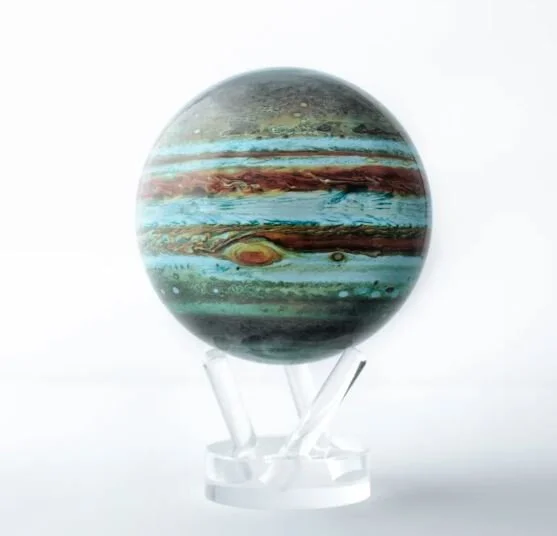
Mova Globes, Powered by Solar Cells and Magnets

MOVA Globes are brand new to Studio Seven Arts. Each globe has a transparent outer shell made from carefully selected, high-quality acrylic. This external layer remains stationary while an internal one spins using advanced magnets for torque and solar cells to power the movement. They move with interior light sources, no batteries or cords are needed to power these globes. MOVA globes are available in three sizes 4.5”, 6” and 8.5”

Can MOVA Globes be placed outside? Although they contain solar cells, MOVA Globes are designed as indoor décor items and actually operate best in ambient light. It is best not to keep MOVA Globes exposed to direct sunlight for long periods of time, as this can lead to the graphics fading.

What happens to MOVA Globes when the lights turn off? They have a sleep cycle just like humans. MOVA Globes will slow down to a complete stop in the absence of sufficient lighting but will come back to life as soon as the lights are turned back on

How to care for your MOVA globe. MOVA Globes need very minimal maintenance. To remove fingerprints and dust, rinse with water and wipe dry with a soft cloth. Do not use any abrasive cleaning solutions.


Tim Huhn's Masterpiece VI Guggenheim

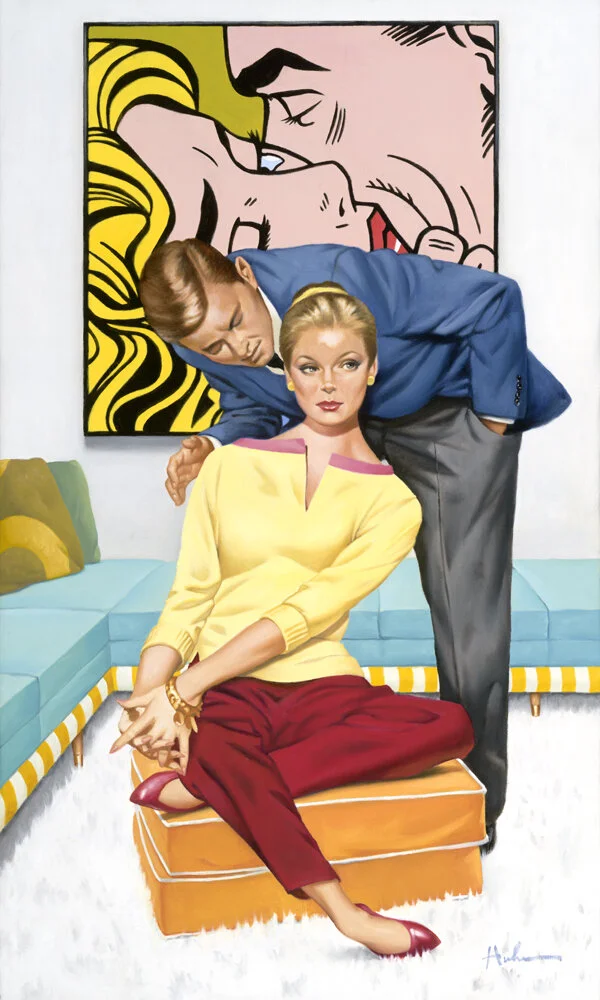
In Tim Huhn’s latest painting ‘Masterpiece VI Guggenheim Self-Portrait,’ Tim depicts a mid-century style couple walking around the Guggenheim Museum during a Roy Lichtenstein Exhibition. In the background, Tim has incorporated a number of Masterpieces by both Alexander Calder and Roy Lichtenstein. These masterpieces include a red, yellow and black mobile hanging in the center area of the Guggenheim Museum by Alexander Calder as well as Roy Lichtenstein’s paintings of 'In the Car' (seen on the top level), 'Whaam!' (seen on the main depicted level far right), 'Yellow and Red Brushstrokes', 'Female Head', 'Crying Girl', and lastly 'Self-Portrait.'

The woman is holding a brochure, referenced from a Lichtenstein Exhibition Poster for the Guggenheim Museum in 1969; coupled with the man, who is pointing over his shoulder realizing that the figure looking at the 'Self-Portrait' painting is Roy Lichtenstein himself!

Tim Huhn’s oil painting on canvas ‘Masterpiece VI Guggenheim’ measures 24”x40”, is also available as a limited edition canvas print that can be purchased in two sizes.

Masterpiece VI Guggenheim Exhibit Self-Portrait 1.jpg

New Mad Men Inspired Art By Tim Huhn

Tim Huhn was raised in the Seattle area, he graduated from the prestigious California college of arts and crafts in 1977. Tim has a long history as a commercial artist working with companies such as Disney, Universal Studios, and Sony Pictures. After retiring to the central coast, he began to develop a body of fine art depicting the Golden Age of Art Deco as his paintings embody the strength and achievements of the 1930’s era. Tim’s extraordinary ability and meticulous attention to detail have moved him to the forefront as a premier 21st century Art Deco painter.

Featured here are Tim Huhn’s latest works inspired by the 50’s and 60’s with Roy Lichtenstein’s famous pop art pieces telling a story that relates to the piece that Tim has created. Look closely at each piece there are easter eggs that connect the pop art to the individual piece created by Tim Huhn.

Todd Goldman Teams Up with Ashlan and Philippe Cousteau For Earth Day NFT Drop

Todd Goldman may be one of the most successful pop artists you don’t think you know, but I’d wager you know his work. Between his brand David & Goliath and other projects, merchandise featuring Goldman’s pop-art has generated over $1 billion dollars globally. He sold 20 million units of his irreverent tee shirt, emboldened with “Boys Are Stupid, Throw Rocks At Them!” and his art has been name dropped numerous times by by Rhianna; you can’t make this stuff up. 

With lots of artists getting into the NFT game, Goldman has chosen Earth Day to enter the space, as it’s an opportunity to both spread awareness of environmental issues and raise money for a good cause.

The numerous, goofy NFTs dropping tomorrow on MakersPlace will generate money to be donated to EarthEcho International. Founded in 2005 by siblings Philippe and Alexandra Cousteau in honor of their father Philippe Cousteau Sr., son of the legendary explorer Jacques-Yves Cousteau, EarthEco collaborates with youth around the world to provide knowledge and tools to drive meaningful environmental action to protect and restore our ocean planet. Reaching more than 2 million people in 146 countries, Phillipe and his wife Ashlan activate the next generation to become environmental leaders who will transform the future. Thus, Goldman’s cheeky designs were a perfect opportunity for collaboration with the non profit.

This drop demonstrates another way NFT technology can be utilized for good; although the pandemic has prevented a lot of traditional fundraising events, NFT drops are an avenue for artists to raise money for a good cause. Earth Day is the perfect opportunity to both drive more awareness to the burgeoning NFT space and raise money for organizations fighting climate change.

The drop goes live on MakersPlace tomorrow, April 22nd at 12pm EST.

Bovano of Cheshire, Coming Soon!

 Bovano of Cheshire began in 1952, when working alone in the basement of his home in Cheshire, Connecticut, whenartist Jim Bower began experimenting with powdered glass fused to small copper plates. His playful approach resulted in early designs applied to small glass enamel plates, which were sold under the name Bower Enamels.

It wasn't long before Jim met John Bonsignor who realized the potential of developing a much wider array of glass-enameled products. John moved the studio to the upper floor of an old foundry building in Cheshire Connecticut and began a passionate pursuit of copper enameling. The name "Bovano" was coined from the first two letters of the last name of each of the three original owners: Bonsignor, Van Leight and Noden.

In 1964 David Flood partnered with John to continue the growth of Bovano of Cheshire. Dave and John collaborated together through the 1960's. It was also during this time that the company made a dramatic change away from copper enameled plates and trays turning instead to the creation of simple little copper enameled flowers. Later designs were extended to larger tabletop flowers, with a growing choice of flowers, bonsai and maple trees, birds and butterflies.

In 1975, David became owner of Bovano of Cheshire. Hotel based trade-shows became his regular destinations he carried products and displays to markets in the New York, Boston and Chicago circuit. Growth of the company continued beyond three decades as an ever-widening range of high quality wall and table sculptures were crafted by hand.

Today, at the start of the new millennium, Bovano artisans continue to use many of the techniques developed from the early days of the company. Combining modern technology and old world craftsmanship, highly skilled Bovano artisans continue creating quality sculptures using the knowledge through decades of experience.

The old foundry building still houses the enameling studio and Bovano Home Gallery. Dave's son Jim Flood, who has been President since 1987, continues to carry forth the Bovano of Cheshire tradition of bringing fine artistic sculptures to you.

The Frogman Tim Cotterill

Tim Cotterill, the world famous Frogman

Tim Cotterill has become the biggest selling bronze artist in the world today with his elegant, stylized, whimsical bronze frogs and his passionate collectors span the globe.

Tim was born in Leicester, England, in 1950. He Left school at the age of 15 and began a 6 year electrical engineering apprenticeship , moving onto landscape design, construction and stone masonry after completing his apprenticeship.

Intrigued with metalworking and fast machines Tim started designing and building radical wheeled vehicles in his spare time. He found his peak interest in the design of welded steel animals and birds during the 1970’s. Tim’s work was well received through private commission, exhibits, galleries and Sotheby’s world renowned auction house in London.

Tim’s curiosity of the diverse lifestyles in California led to many trips to the USA, where his life sized one off welded steel owls, parrots, eagles and hawks were an instant hit at street art shows coast to coast. Over 380 original welded steel sculptures were created from 1972-1990.

Emigrating to California, USA in 1990 and living in a rented 4 car garage in Venice Beach he started designing his now famous bronze frogs. He quickly discovered everyone loved them. Now years later and proudly an American citizen Tim resides in PARADISE, his own funky structure in an industrial area of Venice Beach, California, USA.

With over 200 limited edition bronze frog designs under his belt, Tim thought it was time to go back to his roots by introducing bird sculptures. The Aviary Collection is now available featuring Tim’s favorite birds: Owls, Parrots and King Fishers.

The Foundry represents and manufactures exclusive designs for several world-class bronze artisans, including Tim Cotterill, The Frogman! It is located in Southern California and continues to grow and develop by pioneering innovative color patina applications and cutting edge metalwork techniques coupled with impeccable attention to quality control and finish detail.

About The Foundry

Once Tim has created the master, the sculptures are then all made using the Lost Wax Casting process. This is a process that goes back over thousands of years and the sculptures can take up to 8 weeks to produce. All are created from top quality silicone for the molds and the bronze is hand finished by patina experts, with many years of training and experience.

Each Frogman sculpture is created as a limited edition and an edition number is engraved on every sculpture. Each sculpture will be accompanied with a Certificate of Authenticity, signed by Studio Seven Arts which is an authorized gallery for Frogman sculptures..

How Do You Interpret A Painting?

Artist Leonardo da Vinci, Pablo Picasso, Vincent van Gogh are names of master painters we are quite familiar with. But are we familiar with their work? Can we interpret their work or understand what their paintings are about? Probably not.

In the past art is something that has always been for the wealthy and affluent class, to be educated about, to seek out and collect, some wealthy patrons funded an artist buying their supplies and providing them with a studio to work in. The middle class has been left out when it comes to education and being able to comprehend the art of the masters. Art is a great source of pleasure to many and it also helps to deepen our perspective towards life and death. Learning about and observing art is a passion for some people. They delve into the works of a particular artist and use different perspectives to interpret it.

It is not a difficult process to interpret art and a novice can start with these simple steps-

1) Observe
Art has many aspects that are appealing to our senses. A work might hold your attention due to its subtle nature, subject matter, its beauty, its color, its realistic appearance or many other factors that are of personal taste. Take your time and after having a good look, ask yourself what is it about? Understanding the subject on which it is based is very crucial. It might be a landscape, object or an abstract work.

2) Symbols
Look for symbols. One example, would be the presence of a skull in the picture, the wealthy interpreted that wealth was only worldly, which pointed that their lives were meaningless. Keep in mind that this might not be the artist interpretation of the work. Every individual has a different perspective when they are looking at things. It is best to focus on what the work means and says to you, that is really what art is all about, how do you feel when you look at the work?

3) Style
Style is a reference to the individual artists creativity on the canvas. Their creativity is in the closely detailed work,  controlled work, or the wild ecstatic effect of an abstract. Certain artistic style can also convey a message from that time period and is interpreted different in today’s world.

There are artist’s who will sometimes go out of their way by depicting strong emotions in their painting relating to anger, disgust, lust or even happiness. Art also has a deep emotional streak. Understand what feelings are evoked by seeing a painting and why does it happen? Keep in mind when observing any work of art its’s subject, symbolism, style and self examination that it might bring to you personally. All art does not have to be liked or loved, but finding something about it that you can relate too helps to understand the art.

Images from left to right: Bill Sala, Courtney Jacobs, Heather Edwards, Anne Packard, Charity Anderson, Irene Hardy, Susan Hoehn and Steven McDonald.